

Compactors
A compactor does not change what your staff do. It changes how many times a truck has to come.
You are paying for volume, not weight.
Front-load and roll-off service is scheduled around how quickly a container fills. Reduce the volume of what goes into it and the fill rate falls — which is the only lever that meaningfully changes pickup frequency.
General waste compactors are commonly cited in the 4:1 to 5:1 range, with indoor units reaching considerably higher on dry, bulky material and dense or wet material achieving less. Engineering references from Environment Canada use 4:1 as a working figure for stationary compactors. Actual ratio depends on your material and how the unit is loaded.
The downstream effect is real money. Landfill tipping fees averaged $56.80 per ton nationally in 2023, with the Pacific region at $62.28 per ton, according to the Environmental Research & Education Foundation. Fewer, fuller hauls means fewer trips paying both a haul charge and a disposal charge.
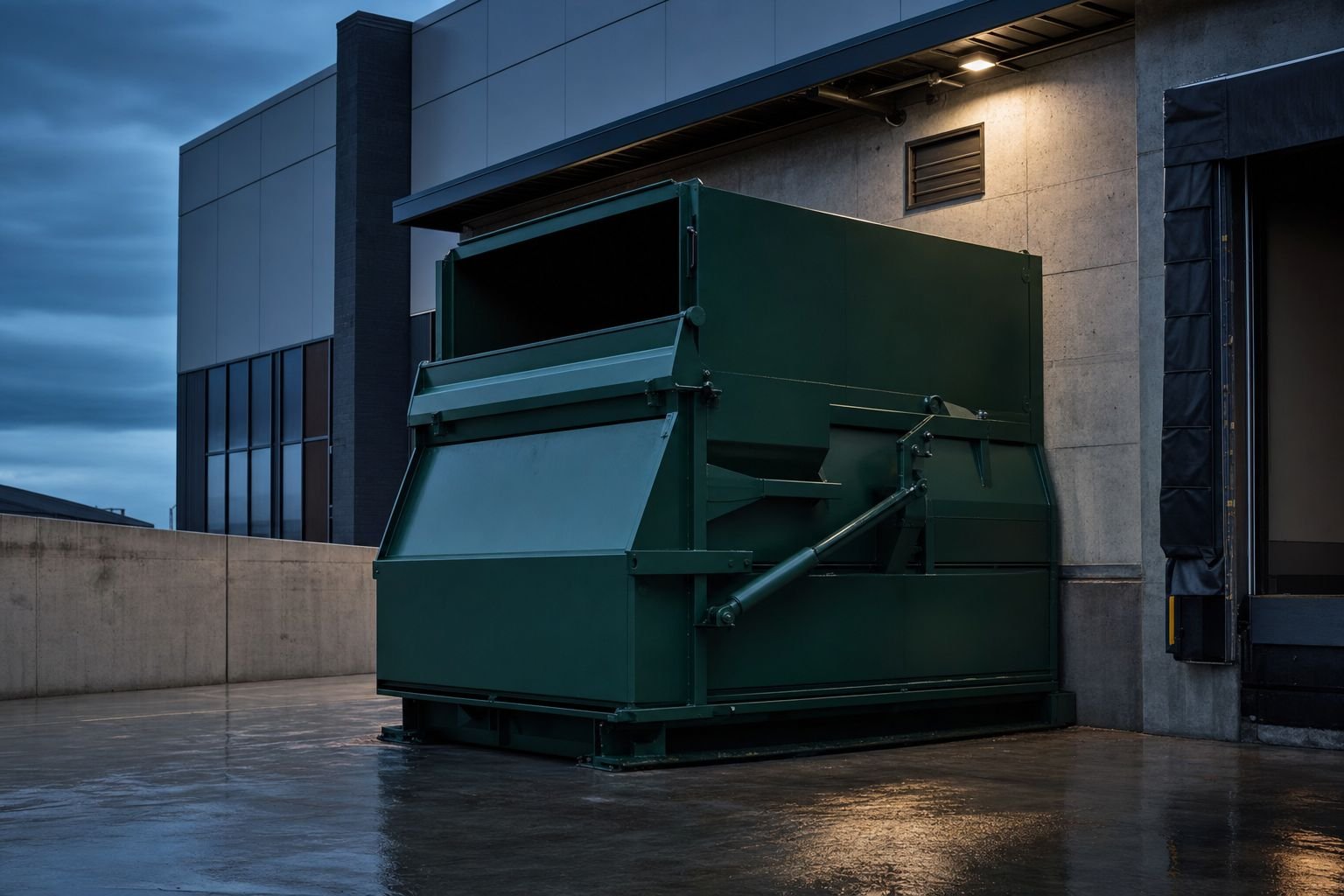
Three configurations, three different problems.
Stationary compactors
The compactor is mounted at the dock and a detachable container is swapped when full. The workhorse configuration for dry general waste at a facility with truck access.
See specifications
| Best suited to | Dry general waste, moderate to high volume, dock-served sites |
|---|---|
| Site considerations | Pad space, container swap clearance, truck turning radius, power at the dock |
| Not ideal for | Wet or liquid-bearing waste, where a sealed unit is preferable |
| Model-level data | Capacities, cycle times, ram force and power requirements to be published once confirmed by Nichols |
Self-contained compactors
Compaction chamber and container are one sealed unit, so liquid stays inside rather than on your pad. The standard answer for food waste, produce and process waste with moisture content.
See specifications
| Best suited to | Wet waste, food waste, liquid-bearing material |
|---|---|
| Site considerations | Drainage, wash-down access, odour control, hauler compatibility with sealed units |
| Operational note | Sanitation performance is often the deciding factor, ahead of compaction ratio |
| Model-level data | Capacities and configurations to be published once confirmed by Nichols |
Vertical & indoor compactors
For sites without dock space or outdoor pad area. Smaller units placed inside the building, often fed by staff or by a chute, reducing volume before material ever reaches a container.
See specifications
| Best suited to | Space-constrained sites, multi-tenant buildings, upper-floor waste rooms |
|---|---|
| Site considerations | Ceiling height, floor loading, access route for the container or bin |
| Model-level data | Capacities and configurations to be published once confirmed by Nichols |
Specification tables above describe selection criteria, not model specifications. Nichols will supply verified capacity, dimension and power data before this page goes live.
Read your hauling agreement first.
This is the part of the process most vendors skip. A compactor reduces how often a container needs to be pulled — but whether that turns into a lower invoice depends entirely on what you signed.
Service minimums
Many agreements set a minimum number of pulls or a minimum monthly charge regardless of volume. That floor caps what compaction can save.
Fixed versus variable charges
Container rental, base service, fuel and environmental surcharges usually do not fall when pickups do. Only the frequency-driven portion moves.
Contract term and change rights
Reducing service often requires a contract amendment. Timing the equipment decision to the renewal date is frequently worth more than the equipment discount.
Compactor-specific rate structures
Compacted containers are often billed differently from open-top or front-load service. Confirm the new rate before assuming a saving.
Nichols Sales is not a party to your hauling agreement and does not negotiate hauling rates on your behalf. We will, however, tell you plainly when a contract term is likely to limit the benefit of new equipment.
Let's confirm the right solution.
Bring a recent hauling invoice and a rough idea of your space. That is usually enough to get to a real answer.