

Grocery & food retail
No other retail format generates this much cardboard in this little space, on this tight a schedule.
The back room tells you everything.
Deliveries arrive all day. Boxes are broken down between other tasks. The cardboard container fills before the week does, and someone calls for an extra pull.
None of it appears as a line item called "waste handling." It shows up as labor, as clutter in a receiving area that also has to function as a staging area, and as a hauling invoice nobody has read closely in years.
Connecticut's state environmental agency estimates supermarkets generate roughly 8 to more than 30 tons of corrugated cardboard per month, with convenience stores at around 700 to 1,000 pounds monthly. At the low end of that range, cardboard is a housekeeping problem. At the high end, it is a budget line.
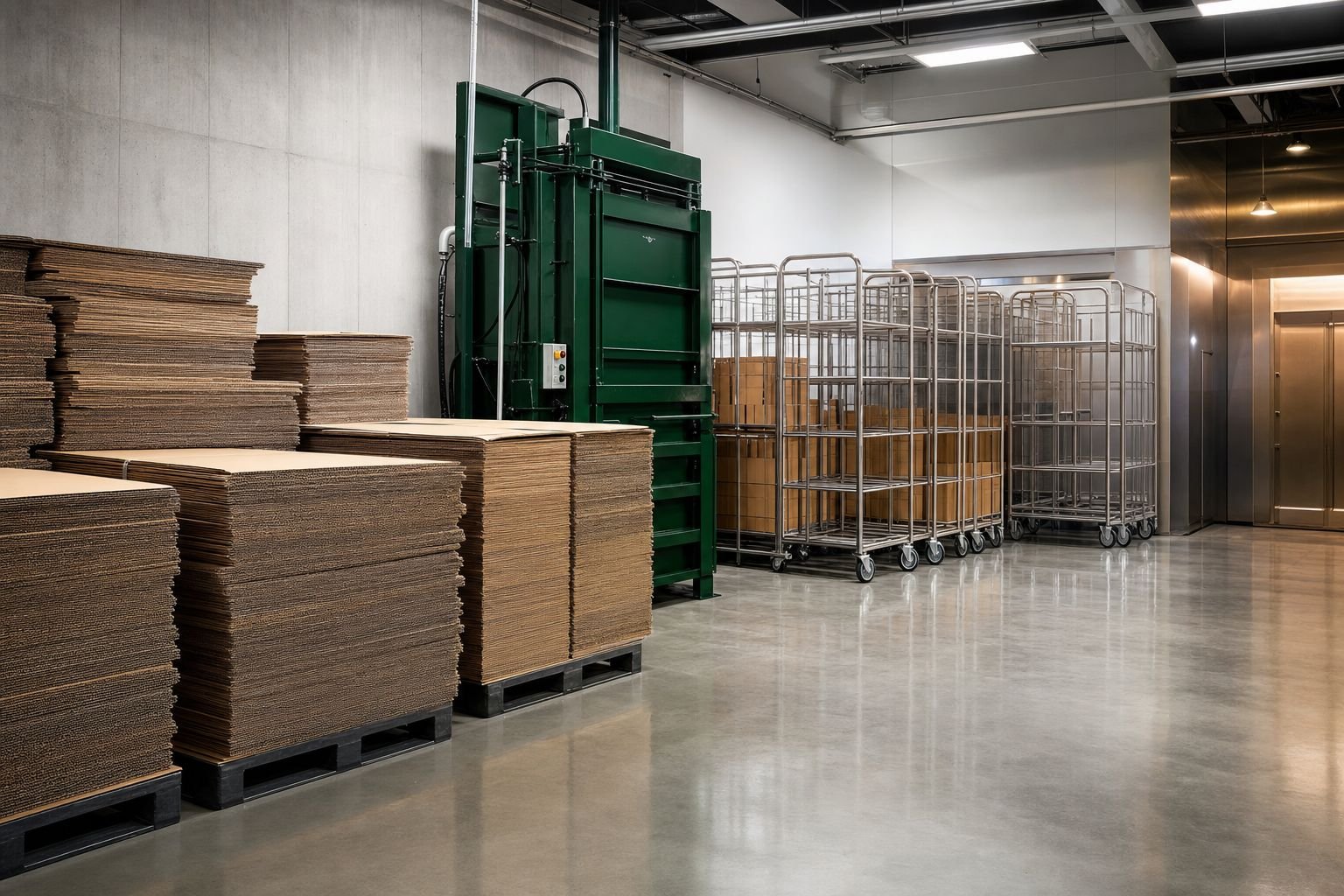
Grocery is really two waste problems.
Treating them as one is the most common and most expensive mistake in this category.
Dry: cardboard and film
High volume, low weight, and highly recoverable. Corrugated boxes were the largest single product category in U.S. municipal solid waste at 11.4% of total generation, with a 96.5% recycling rate, in EPA's most recent published data (2018). A baler moves this stream out of your waste cost and into a commodity — or at minimum out of the container that drives pickup frequency.
Wet: produce, food and prep waste
Lower volume, much heavier, and a sanitation issue rather than a recovery opportunity. This is what self-contained compactors exist for: the chamber and container are one sealed unit, so liquid stays inside rather than on the pad behind the store.
Where the return usually comes from.
In grocery specifically, the commodity check is rarely the biggest line. Time and space are.
Handling time
One trip to a baler beats repeated trips to an overflowing container. Baling consolidates handling into a single predictable task instead of a running one.
Floor space
Bales stack. Loose cardboard sprawls. In a back room measured in feet, that difference is operational, not cosmetic.
Pickup frequency
Removing the bulkiest stream from the trash container slows the fill rate, which is the only thing that can potentially reduce how often a truck is scheduled — subject to your contract terms.
Commodity value
Real, but volatile. Reported U.S. OCC averages ranged from roughly $45 to $100 per ton across indices during 2026 (Packaging Dive). Treat it as upside, not as the basis of the decision.
Housekeeping and safety
Clear aisles and clear docks. Less material stacked where it should not be.
Outcomes vary by store format, delivery frequency, waste composition, available space, staffing and the terms of your hauling agreement.
One store is a purchase. Fifty stores is a program.
Chains have a different problem: not which machine, but how to standardise across sites that differ in space, power, volume and hauling contracts — and how to keep every one of them running without a facilities team fielding calls store by store.
That is a rollout conversation: site surveys, a small number of standard configurations rather than one, phased installation, consistent operator training, and a single service path.
Nichols to confirm multi-site capability specifics: largest rollout completed, whether national accounts are supported, whether service across multiple states is direct or through partners, and whether any named grocery or food retail customers can be published as references.
Start with your back room.
Bring a recent hauling invoice and a rough measurement of the space. That is usually enough for a real answer.